Sunday, January 20, 2019

Citation II type rating - Day 12 - checkride prep

It was checkride prep day!

Started off in the simulator, essentially running through everything that will likely be on the checkride. The entire flight was at (or near) JFK.

After an aborted takeoff, the second takeoff, climb to altitude and airwork went great - steep turns, stalls (clean, takeoff, and landing configurations) - no problems there. Back to the airport for the ILS RWY 22L using the autopilot to minimums, and missed approach.

On the missed approach, an engine failed and we shut it down (no restart). Vectors to the ILS RWY 4R, single engine. Nearing glideslope intercept he had me turn off the autopilot and hand fly (we knew this was coming). And the minute I did, everything started getting out of hand.

I was having a really hard time following the flight director. Every time I'd turn to follow it I think I was on it, I'd drift off heading. I weaved all the way down final! It was somewhat humbling, because I've always considered the single-engine ILS on checkrides to be something that people worry too much about, they are usually pretty straightforward once you have the airplane all trimmed up. And I think that was my problem - I may not have had the rudder properly trimmed when I had engaged the autopilot after the engine failure, and so the autopilot masked that out-of-trim condition. Until, of course, the point where I turned it off just as I intercepted glideslope, and never really got stabilized.

The ground track, or at least what it felt like to me!
So, doing my bobbing and weaving down final, once the runway was in sight (with 1/2 mile visibility), I was not in a good position to land, and went around. Fortunately this was still a training event, not a checkride, so the instructor just repositioned me back outside glideslope intercept on a vector. The second try was much better and I landed safely. Whew!

Following that I got things back together. Takeoff, engine failure, successful restart, RNAV (GPS) RWY 4R with a go-around/missed approach due to pink elephants on the runway or some such thing, and then the VOR RWY 4L, full procedure from the JFK VOR, circle-to-land runway 31R. They teach a local technique for the circling part of this that works every time if you do it right.

Landed, took off again, and vectors for the visual approach to runway 13R with inoperative flaps (stuck at 0 degrees). No problems there either.

And apparently, that's pretty much the checkride! You can bet I will really be focused on that single-engine ILS - we've done them before and I had no problems, so I'm sure I'll be okay.

After the sim, we did a couple hours of prep for the oral part of the checkride. I was way more worried about this than the flying part, but it seems pretty straightforward and I don't anticipate any problems. I've been studying the aircraft systems for about 6 weeks now, so hopefully some of it has stuck!

Saturday, January 19, 2019

Citation II type rating - Day 11 - Hot weather day

The main focus of today was high temperature and high altitude performance, or rather lack there-of, with one engine inoperative. But of course the syllabus graciously added a few other things to keep it interesting.

The flight was from Reno, NV to Redding, CA on a summer day. Density altitude was about 6300 feet. Reno's "HUNGRY THREE" (hah!) departure from runway 34L requires a climb gradient of 315 feet per nm to 8400:


This calculates to about a 5.25 percent climb gradient. We used the Citation II performance charts to determine that we could make this gradient, assuming an engine failed on takeoff, at a maximum of 11,500 pounds (1,800 pounds short of the maximum takeoff weight). So, it seems we might have to leave some of our Reno gambling winnings behind...

And so we did. The engine failed on takeoff roll, just above abort speed (V1) and I continued the climb, apparently missing the cloud-hidden mountains all around. Once this were settled down we restarted and went on our way to Redding.

Along the way we had a cabin depressurization and emergency descent. Pitching the plane over for a maximum-speed dive with the speedbrakes out was a lot of fun in the simulator. I bet not as much in real life.

Flying ILS into Redding, we were warned of thunderstorms in the area and possible windshear. And wouldn't you know it, we ran into bad windshear on short final! Recovery procedure is throttles to maximum and pitch up as much as necessary to arrest the descent rate. "As much as necessary" is all the way up to just short of a stall.

Fortunately, we have this to guide us, an Angle-Of-Attack indicator:


Pitching up into the yellow band is recommended for windshear escape. The crosshatched area around .85 is where the airplane will stall. We used this previously during the stall maneuvers and it works very reliably in any configuration - once the AOA gets to the crosshatched area, the plane buffets every time.

We were told that the windshear event being simulated was the Dallas-Ft Worth event that brought down Delta Flight 191 on August 2, 1985. That event really started a lot of the research into windshear and microbursts. Even knowing it was coming, and even being in a simulator, it was definitely enough to get the heart pumping! Fortunately we were able to make a missed approach and fly out of it eventually.

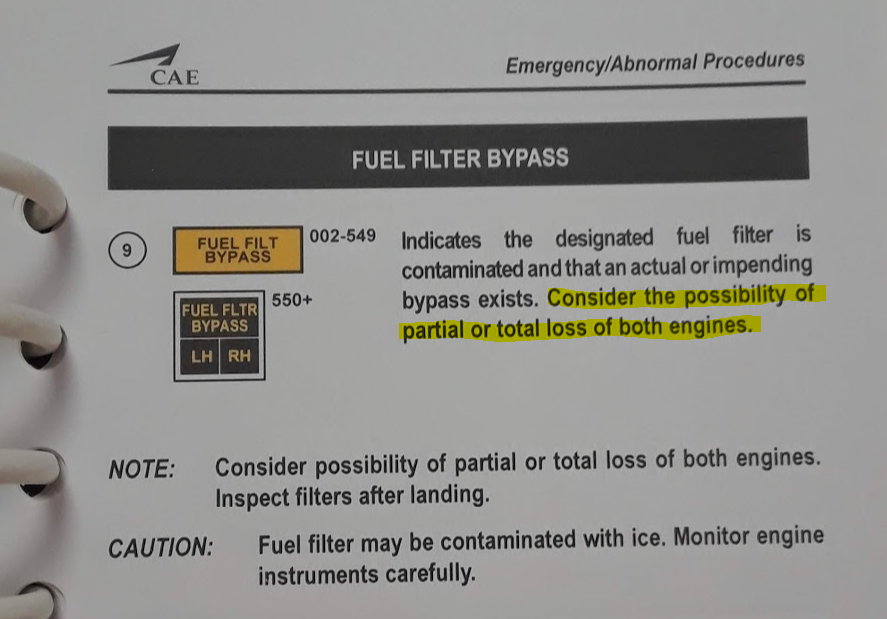
We followed that with a LOC/DME back into Redding. Funny how the windshear also damaged the glideslope antenna. On vectors for this came a "Fuel Filter Bypass" light. Not much of a checklist for this one, but the warning does get your attention (so much they put it in there twice).


And sure enough, one of them did decide to give up on final.

Landed, fixed the engine and went back around for a practice visual approach. Of course that meant a runaway elevator trim problem to identify and disable before it drove us into the ground!

I am feeling way more comfortable in the airplane than just a day or two ago. Even considering everything that happened on the flight today, it was actually a pretty easy flight. Is that a good sign, or not? Don't know!

Tomorrow is our checkride prep day!

Friday, January 18, 2019

Citation II type rating - Day 10 - Cold weather day

Jepp charts. Lots of professional pilots use them. I never have, neither does almost anyone I know. But of course that's what we're using in training, so although I could just bring up FAA charts on Foreflight, I decided to just learn the Jepps. Approach charts I had seen enough before that I didn't need a whole lot of practice with them. But for SIDs and STARs I've never used and have only rarely seen the Jepp versions!

Compare:


With:


I definitely had to hunt around to find the information.

Today as you may have guessed we flew from Seattle Intl. It was simulating a cold weather day, with snow at SEA, low IFR, and icing conditions along our route, which took us down to Portland Intl, PDX.

It was another day of problems. Engine anti-ice failure, bleed air leak, anti-skid brake system failure, generator failure, engine fire, circuit breaker panel fire, low hydraulic level and pressure, and of course the landing gear wouldn't extend!

In addition to that, we flew three instrument approaches at PDX. The first one was the most challenging - the PDX LOC/DME RWY 21.

Of course we started at BTG VORTAC and had to fly the whole thing, procedure turn and all. Look at all those stepdown fixes! In addition, it's steeper than normal, at a 3.43 degree descent angle, and sure enough I was having trouble keeping the speed under control while making that descent. Had to use the speedbrakes a few times but I imagine I probably could have avoided that with a little better speed and descent planning.

The instructor must have had the visibility set at about 1/2 mile, because once we finally did see the runway I was too high and close (700 MSL/674 AGL) for a safe approach. Missed approach, the published one, of course! This approach is just as busy or even moreso for the copilot who has to set all the radios, altitude preselects, run the checklists and keep the pilot out of trouble. It's a good training approach!


Tomorrow we sweat - "high temperature day" and engine failures in mountainous terrain. That checkride is getting closer!

Thursday, January 17, 2019

Citation II type rating - Day 9 - Lousy engines!

I thought jet engines were supposed to be very reliable - well not today they weren't!

It was "Engine Failure Day". That's not what they call it, but they should. We had low oil pressure, we had clogged fuel filters, we had engine fires, we had bird strikes.

They failed on takeoff roll. They failed after V1. They failed in cruise. They failed on approach.

Throw in a couple of other more minor issues like flaps not extending and the AC system failing (that's AC as in "AC power" not as in "Air Conditioning", although that would also be a true emergency in the summer!)

I can't even begin to remember the order of everything. But we did fly around single-engine most of the day. Even did some single-engine missed approaches. Good times.

Flew four instrument approaches each, and one visual approach (oh sure it was easy until the flaps broke and the engine fire light came on...) The instrument approaches were two ILSes, one Localizer-only, and one NDB.

Yes, I said NDB.


Why? I have no idea. I assume the Citation II training syllabus was approved by the FAA in 1947 and not updated since. Okay, maybe not that long ago. Now, NDB approaches are great for building situational awareness but I just can't think of a good reason for them to be in this type rating course in 2019. If you really did need to be able to fly them, you should seek out additional training.

Granted, it was kind of fun. I don't remember the last time I flew one for practice. Fortunately we were given vectors to final and it was pretty straightforward at that point. And it actually turned out pretty well for me!

I definitely learned today that the copilot can easily be busier than the pilot. There were so many checklists to run, right after each other, that it got a little hectic and confusing sometimes. Especially since the problems always seemed to happen at absolutely the worst time - while setting up for an approach, for example. However, we got very good at saying "Citation 2SF request delay vectors to work the problem", as you would likely do in real life.

My sim partner is a former airline pilot who hasn't flown for about 10 years. I, on the other hand, am very current but have never flown in a two-person crew environment. I want to do everything myself in the plane (whether I'm pilot or co-pilot), but am learning to call things out to him. We're helping each other out as much as we can.

Tomorrow will hopefully be a bit less exhausting. We're simulating a cold-weather (meaning icing) trip from Seattle to Portland. Good times!

Wednesday, January 16, 2019

Citation II type rating - Day 8 - Maneuvers and approaches

What a day! Showtime was at 6 AM so we could make up my sim session from yesterday. Fortunately we had already briefed last night so we were able to get right to it.

Started off with my "S1" lesson, with me in the left seat. We did the three type of stalls mentioned before, steep turns, and then back to JFK for the ILS OR LOC RWY 22L.

The steep turns went okay, especially on the second try. Stalls really weren't any different than in any other plane I've flown them in, easily controllable and the recovery actions were the same.

We then returned for the ILS. The instructors had prepared us for the power settings and such for the various segments of an approach, and with the autopilot running it was no big trick to make sure I was on speed. The instructor showed me the plot of glideslope and ground track, where he was happy with the consistent speed at about Vref + 10 (the top number on each pair of white numbers). Although, honestly, I just set the power, it seemed to be working, so I left it alone!


Time for a quick break, then back into the sim for my partner's "S2" lesson - review of steep turns, stalls, an engine failure in cruise, and non-precision approaches. While he's flying, of course, I'm running checklists and trying to stay ahead of the game so I can help him out as needed - course reminders, altitudes, and such.  At the end of his flying it was my turn for a RIGHT seat takeoff and approach. Now, I sit in the right seat several times a week in training, and have flown from that seat quite regularly. So I didn't think it would be that big of a deal, but it was. Although this aircraft has full instrumentation on the right side, it's not as complete or as integrated as the left side. So it was a bit more work. The autopilot was also randomly disengaging too (not caused by the instructor), which was creating some confusion and difficulty. I was vectored for the JFK VOR/DME RWY 22L, and flew it "okay". Since the autopilot was randomly disengaging, I just turned it off. Notice below there is no plot of my ground track for this one!

Then it was my turn in the left seat again.

By this time we had been in the sim about 4 hours (yes we got a break halfway) so I was getting a little tired. But we started off at Teterboro, NJ with the Teterboro Two Departure, a departure that is known for having pilots bust the 2000 foot initial altitude. It doesn't take long to get there! But with the two of us we managed just fine.

Tereboro Two Departure


Cleared up to 10,000 suddenly the right engine gave up on us as we were passing 6000. We told ATC we were leveling off to work the problem. Shut it down and then restarted it. This is something I have done in twin-engine piston aircraft reasonably often, but it's so much less work with a two-person crew! It was really a non-event. Resumed climbing to 10,000.

Then we worked into some steep turns and stalls again, and I am happy to say they went great! Of course, the fact that I had just practiced them 2 hours earlier helped a lot. Back to the JFK VOR for the full VOR RWY 4L, circle to runway 31. I had the benefit here of having seen it during my partner's flying, so I knew what to expect. We even did a turn in holding at the FAF. Descending, broke out of the clouds , turned right to circle to 31, and pulled off a decent landing.

KJFK VOR RWY 4L

My partner got his turn for the right seat takeoff, approach and landing, then I took back the airplane to fly the KJFK RNAV (GPS) RWY 4R using the UNS-1 FMS. Functionally pretty much the same as a Garmin 430 without all the features. LNAV-only, no LPV, so leveled off at MDA and fortunately saw the runway.

And then we peeled ourselves out of there and ate lunch.

Back tomorrow at 6:30 AM!


Tuesday, January 15, 2019

Citation II type rating - Day 7 - First real sim session

12:30 PM show for the first sim lesson today! Fortunately when I got there it was empty...


Okay, that's actually a beautifully restored Link trainer from back in the 30's and 40's in the main atrium at CAE.

https://en.wikipedia.org/wiki/Link_Trainer

How the sim sessions work at CAE is you are allocated an hour before the sim for prebrief and an hour afterward for debrief. Each pilot gets about 2 hours as pilot and 2 hours as copilot. So, 12:30 show means 1:30 in the sim and done by 6:30.

At least that's how it's supposed to work!

We showed at 12:30 only to find out the sim had broken a little while before and they were trying to fix it. Unfortunately, it also meant that the previous session hadn't been completed and they still had about 3 hours left. Now, there isn't a lot of spare time built into the schedule - I'll be in the sim every day until my checkride on Monday. So lots of different scheduling options were being thrown around (including slipping every, including my checkride, one day - ugh), but it all depended on how quickly the sim could be fixed. Fortunately it didn't take too long (a few hours) so the decision we settled on was to only do half (2 hours) or our sim session today, and do a session and a half tomorrow (6 hours). The instructors and the scheduling office worked quickly together to make sure this would work.

We finally got into the sim at about 4:00 PM today. Since we were only doing half a session, only one of us got to be pilot. I went ahead and served as copilot for today (but I'll do the exact same flight tomorrow morning as pilot).

Sim lesson 1 is a pretty basic intro to checklists and flying the sim. No emergencies or abnormal conditions for this flight! On the ground at JFK, we ran through all the startup checklists, and lined up on runway 4R.


Cleared for takeoff, we flew the Kennedy Five Departure, navigated to a VOR (remember those?) and then proceeded into the "practice area". The main maneuvers for today were steep turns, stalls (clean, landing, and takeoff configuration, that last one with a turn) and an ILS approach.

The steep turns seemed pretty straightforward, nothing that would be unusual to any Private Pilot. The stalls were also very benign and predictable - having an AOA indicator here helps a lot, you know exactly when it's going to stall. Recoveries were also straightforward, using pretty much the same methods you'd use in a 172. Well, I guess a 172RG anyway. Of course that's all from the right seat, I'll see if I think they're so simple after tomorrow's lesson!

From the copilot's side I was busy running checklists, calling out speeds, and generally helping the pilot out. Even got to say familiar things like "watch your altitude" - sounds a lot like flight instruction!

Just about 2 hours total in the sim today. More tomorrow!

Monday, January 14, 2019

Citation II type rating - Day 6 - last day of ground school

After a much-anticipated day off yesterday, today was the last day of ground school. I can't say I'm sad about that. It has been pretty intense and we have covered a lot of material in these six days.

Today we finished up on abnormal procedures with the remaining aircraft systems that we didn't get to before, such as the pressurization system, spending some time reviewing and running through the checklists for the various conditions.

To start to prepare us for our first "real" simulator session tomorrow, the instructor took us through some of the maneuvers we would be performing and how to set up for them. These maneuvers should look really familiar to pilots of all types of aircraft!

  • Steep turns
  • Stalls (clean)
  • Stalls (takeoff configuration)
  • Stalls (landing configuration)
  • Instrument approach power settings
  • Visual approach power settings
We had some time left at the end of the day so we went through a little bit of review for the oral part of the checkride. I'm glad we did, it showed me some areas I need to study a little more!

One thing I'm trying to get better at is quickly finding the appropriate circuit breakers. This is the pilot's side panel, the co-pilot's side has about the same number of breakers.


I don't know if this is a lot or not, but it's certainly a lot more than the planes I have flown previously. Further, many of the abnormal checklists require you to pull circuit breakers, so knowing where they are saves a lot of heads-down hunting for them. I'm still working on that.

But I am very excited to be done with ground school, since of course that means tomorrow we are finally in the sim!